
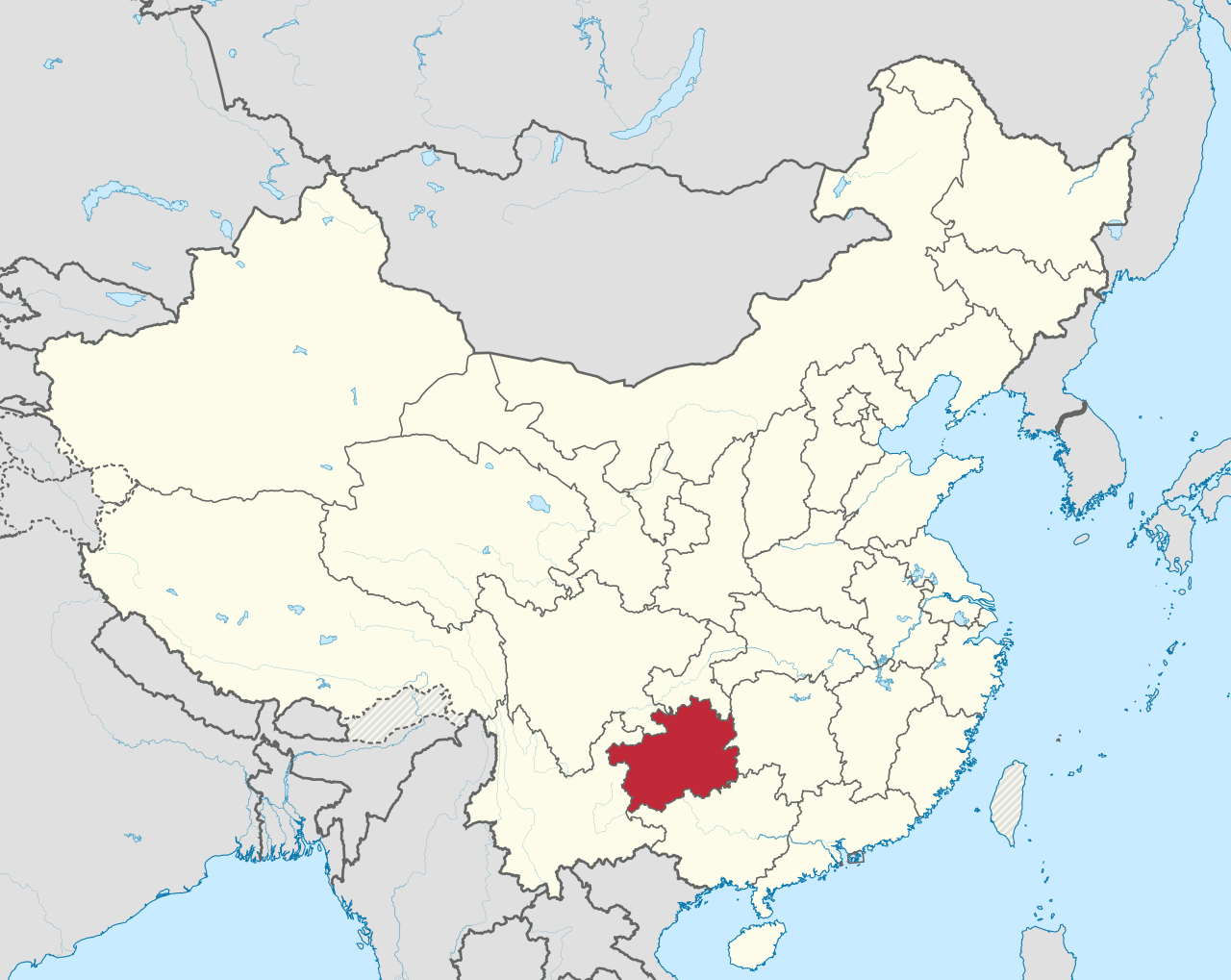
Guizhou
Guizhou is an inland province in Southwestern China. Its capital and largest city is Guiyang, in the center of the province. Guizhou borders the autonomous region of Guangxi to the south, Yunnan to the west, Sichuan to the northwest, the municipality of Chongqing to the north, and Hunan to the east. Guizhou has a humid subtropical climate. It covers a total area of 176,200 square kilometers and consists of six prefecture-level cities and three autonomous prefectures. The population of Guizhou stands at 38.5 million, ranking 18th among the provinces in China. The Dian Kingdom, which inhabited the present-day area of Guizhou, was annexed by the Han dynasty in 106 BC. Guizhou was formally made a province in 1413 during the Ming dynasty. After the overthrow of the Qing in 1911 and following the Chinese Civil War, the Chinese Communist Party took refuge in Guizhou during the Long March between 1934 and 1935. After the establishment of the People's Republic of China, Mao Zedong promoted the relocation of heavy industry into inland provinces such as Guizhou, to better protect them from potential foreign attacks. Located in the hinterland of the southwestern inland region, Guizhou is a transportation hub in the southwest area and an important part of the Yangtze River Economic Belt. It is the country's first national-level comprehensive pilot zone for big data, a mountain tourism destination and a major mountain tourism province, a national ecological civilization pilot zone, and an inland open economic pilot zone. The representative historical culture is "Qian Gui culture"(黔贵文化). In addition, Guizhou is also one of the birthplaces of ancient Chinese humans and ancient Chinese culture, with ancient humans living on this land since about half a million years ago. Guizhou is rich in natural, cultural and environmental resources. Its natural industry includes timber and forestry, and the energy and mining industries constitute an important part of its economy. Notwithstanding, Guizhou is considered a relatively undeveloped province, with the fourth-lowest GDP per capita in China as of 2020. However, it is also one of China's fastest-growing economies. The Chinese government is looking to develop Guizhou as a data hub. Guizhou is a mountainous province, with its higher altitudes in the west and centre. It lies at the eastern end of the Yungui Plateau. Demographically, it is one of China's most diverse provinces. Minority groups account for more than 37% of the population, including sizable populations of the Miao, Bouyei, Dong, Tujia and Yi peoples, all of whom speak languages distinct from Chinese. The main language spoken in Guizhou is Southwestern Mandarin, a variety of Mandarin.
One-Day Guizhou Tour Itinerary Recommendations
Theme:
Mountain Wonders + Ethnic Culture + Sour-Spicy Flavors
Suitable for:
Short trips to Guiyang/Qiandongnan/Anshun, optimal with high-speed rail + scenic shuttle
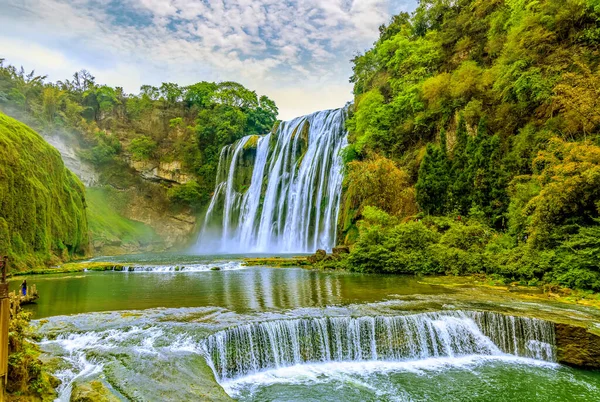
Practical Tips
Tickets:
Miao Village ¥110 (includes shuttle) | Huangguoshu ¥160 (peak season) | Museum free
Ethnic Experiences:
12-course "Block-the-Gate" wine (optional) | Buyi "Eight-Tone" folk music
Transport Notes:
Guiyang metro covers downtown | Organized tours recommended for villages/waterfalls
Optimization Tips:
Guiyang alternative: Mysterious Stone Castle at Yelang Valley
Overnight in Miao Village for crowd-free mornings
Huangguoshu best May-Oct (bring non-slip shoes)
(Note: Attractions are scattered—focus on 2-3 spots per day!)
Option 1:
Guiyang Cultural Discovery
Best for:
History lovers, foodies
Transport:
Metro Line 1 + bus
07:30-09:30 Qianling Mountain Park
¥2.5 wild macaque viewing | Hongfu Temple vegetarian meal | City views from Kanzhu Pavilion
10:00-12:00 Jiaxiu Pavilion + Wenchang Pavilion
Ming Dynasty architecture | Calligraphy at Cuiwei Garden
12:30-14:00 Old Guiyang Lunch
Recommended: Silian Sour Soup Rolls + Lei Family Tofu Balls
14:30-17:00 Guizhou Provincial Museum
Miao silver ornaments + paleontological fossils | 4D "Colorful Guizhou" film
18:00 Qingyun Road Night Market
Liuyishou grilled fish + rose ice jelly | Try Houttuynia cordata dipping sauce
Option 2:
Xijiang Miao Village Experience
Best for:
Photographers, culture seekers
Transport:
High-speed rail to Kaili South + shuttle
07:00-09:00 Arrive at Kaili South Station
09:30-12:00 Thousand Household Miao Village
Morning mist over stilt houses | Try embroidery/batik
12:30-14:00 Long Table Banquet
Sour fish soup + glutinous rice wine | "Flowing Mountain Water" toast ritual
14:30-17:00 Terrace Fields
Hiking + Lusheng performances at Wind-Rain Bridge
18:00 Night Illuminations
Rent Miao costumes | "Beautiful Xijiang" ethnic dance show
Option 3:
Huangguoshu Waterfall Adventure
Best for:
Nature enthusiasts
Transport:
High-speed rail to Anshun West + shuttle
07:00-08:30 Arrive at Anshun West Station
09:00-12:00 Huangguoshu Waterfall
Walk behind curtain (raincoat needed) | 360° viewing platforms
12:30-14:00 Buyi Ethnic Lunch
Duoduofen noodles + rice rolls
14:30-17:00 Doupotang + Tianxing Bridge
"Journey to the West" filming location | Silver Chain Waterfall
18:00 Return to Guiyang
Stop at Qingyan Ancient Town for braised pork knuckles (free night entry)